
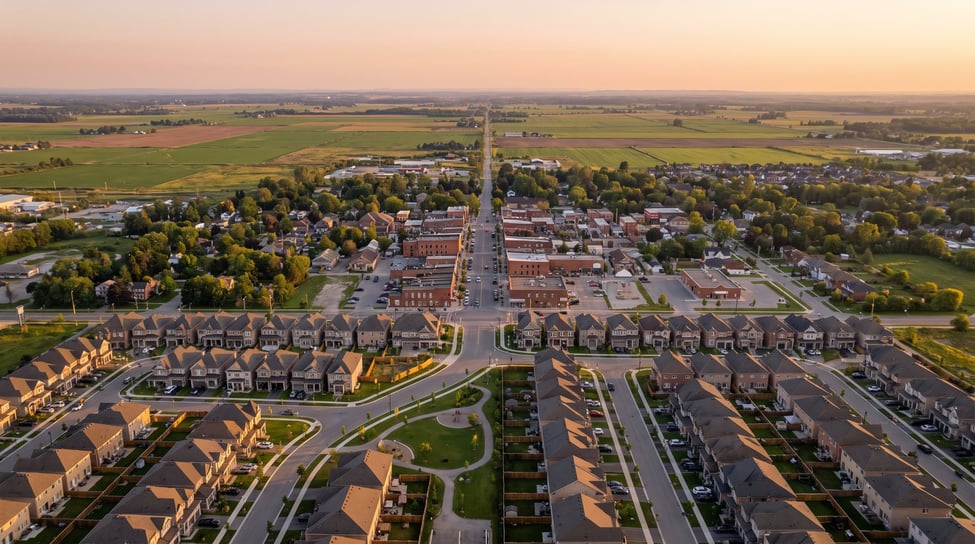
Bradford used to be the town you drove through on the way to somewhere else — a stop on Highway 11, carrot fields on the horizon. Not anymore. Bradford West Gwillimbury is now one of the fastest-growing municipalities in Ontario, and I'm having more buyer conversations about it every month, usually starting with some version of "we looked at Newmarket and the math didn't work." If that's you, here's the honest rundown: what homes actually cost, how the commute works today and how it's about to change, and where I'd be looking if I were buying in.
What homes cost in Bradford right now
This is Bradford's whole pitch, so let's lead with it. As of late summer 2026, a detached home typically sells in the high $800s — recent median sales sit around $890,000 — with newer four-bedroom subdivisions running into the mid $900s and up. Freehold townhouses trade in the low-to-mid $700s. New construction is a real option here in a way it isn't in most of York Region: builders are actively selling, with detached homes starting around $900K and towns from roughly $700K.
Put that against the neighbours and the value story writes itself. The same detached house costs roughly $200,000 more in Newmarket — I've broken that market down in my Newmarket buyer's guide — and Toronto isn't even in the same conversation. Barrie is Bradford's closest price rival, and choosing between them mostly comes down to commute and lifestyle, which we'll get to.
Renting while you scout? Bradford's rental market is tight, especially for family-sized homes — a four-bedroom house runs about $3,400 a month and doesn't sit long. That tightness tells you something about demand here.
The commute: the GO train, the 400, and the Bypass that changes everything
Bradford GO sits on the Barrie line, and the train to Union takes about an hour and a quarter. Door to door, call it 90 minutes to a bit more — workable on a hybrid schedule of two or three office days, which is exactly how most of my Bradford buyers live. Driving, Highway 400 is minutes west of town, and on a clean run downtown Toronto is about an hour. Rush hour is another story, as it is everywhere north of the city.
Here's the part that separates Bradford from every other town in this price range: the Bradford Bypass. The new highway linking the 400 to the 404 across the top of town is under construction right now. When it opens, Bradford becomes the hinge between Ontario's two big north-south corridors — the east side of the GTA suddenly gets much closer, and so does everything along the 404. Highways like this tend to get priced into a market before the ribbon is cut, and you can already feel it in the new-build activity. I won't promise you appreciation — nobody honestly can — but I will say infrastructure of this scale doesn't happen to a town twice.
Is Bradford a good place to live?
It's a genuine small town that happens to be growing quickly, and that combination is rarer than it sounds. Holland Street still functions as a proper main street. Carrot Fest takes over downtown every August — the Holland Marsh next door is some of the most productive farmland in Canada, and the town has never pretended otherwise. The community is one of the most diverse in Simcoe County, with a Portuguese heritage that goes back generations and shows up in the bakeries.
The practical stuff holds up too. The BWG Leisure Centre covers pools, ice and gym under one roof. The library is one of the better small-town libraries you'll walk into. Schools run through the Simcoe County boards, and new schools keep arriving alongside the subdivisions. Southlake hospital in Newmarket is 20 minutes away, and Barrie's RVH about 25 the other direction.
What should you go in with eyes open about? Growth is the town's story and also its friction: new subdivisions have outpaced some of the retail and restaurant scene, so for a big-box run or a proper night out you'll often end up in Newmarket or Barrie. And parts of town still have that under-construction feel — if you buy into a new phase, you're living with builders' trucks for a couple of years. Some people hate that. Others see it as the visible version of buying early.
Where to buy: Bradford neighbourhoods and new developments
Downtown / the older core: the streets around Holland Street carry the town's original housing stock — solid brick, mature trees, walkable to the GO station on a good morning. Best character per dollar in town, and the first place I look for buyers who want a house that doesn't match its neighbours.
Summerlyn Village (west side): the established family subdivision — schools, parks and the Leisure Centre close by. This is where a lot of the four-bedroom demand concentrates.
Grand Central / Dreamfields (north and east): newer phases with the larger modern floor plans. If you want a 2020s-built home without a 2020s-Toronto price, start here.
Green Valley Estates (southeast): newer streets on the marsh side of town, popular with buyers commuting down the 400 corridor.
Bond Head (west, past the 400): the village-and-estate-lot option, now with new golf-course-adjacent development arriving. More land, more quiet, more driving.
One practical tip from my files: the grade changes on Bradford's newer streets mean walkout basements show up here more often than you'd expect — worth flagging to your agent early, because they're the cheapest way to buy an extra floor of living space, and I hunt for them specifically.
Bradford vs Newmarket vs Barrie
Bradford wins on price for a modern house, new construction supply, and the Bypass upside. You trade some amenities and a slightly longer train ride.
Newmarket wins on completeness — hospital in town, Viva transit, a historic Main Street, York Region schools — and charges you a couple hundred thousand for it. The full picture is in my Newmarket guide.
Barrie wins on lifestyle-per-dollar — the waterfront, ski hills, a real restaurant scene — at similar money to Bradford but 30 minutes further from Toronto. My Moving to Barrie from Toronto guide runs those numbers properly.
And if none of the three quite fits, East Gwillimbury sits one concession east with ravine lots and newer builds — I've rounded up East Gwillimbury homes on deep greenspace lots that make the case.
Moving to Bradford: quick answers
How far is Bradford from Toronto?
About 65 km from downtown. Roughly 75 minutes on the GO train, an hour driving off-peak via the 400.
Is Bradford cheaper than Newmarket?
Meaningfully. Detached homes run roughly $200,000 less for comparable size and age, and Bradford's new-construction supply gives you options Newmarket simply doesn't have anymore.
What is the Bradford Bypass?
A new provincial highway under construction that will link Highway 400 to Highway 404 just north of town. For residents it means faster access to the east GTA; for the housing market it's the kind of infrastructure that tends to anchor long-term demand.
Is Bradford a good place to raise a family?
Yes, with the caveat that it's a growing town, not a finished one. Schools, rec facilities and parks are all in place and expanding; the trade-off is a thinner restaurant-and-retail scene than Newmarket, twenty minutes away.
What salary do you need to buy a house in Bradford?
Roughly speaking, a household income in the $160,000–$180,000 range carries an average detached home with 20% down at 2026 rates, and townhomes bring the bar down from there. Your debts, rate and down payment will move that number — treat it as a compass, not a pre-approval.
Want the ground-level version?
Data gets you to Bradford; the right street keeps you happy there for a decade. I work across Simcoe County and York Region every week and I've walked the phases, the older blocks and the Bond Head lots. Get in touch and I'll tell you which pockets I'd shortlist for your budget — and which new-build incentives are actually worth something this fall.
Robert Lawrence | The Lawrence Group
Prices and figures are approximate and current as of early September 2026. Confirm your own numbers with your mortgage broker before you set a budget.